

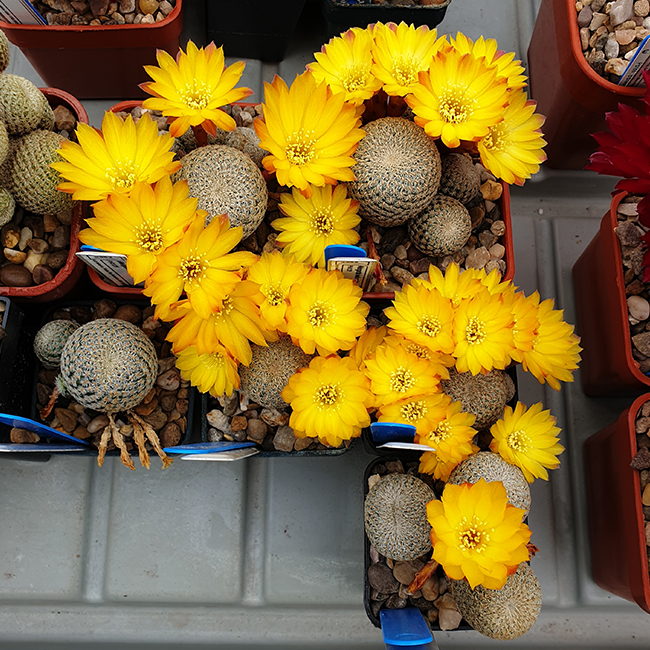
Aylostera oculata is included by some as a form of A. einsteinii. Also sometimes seen as a form of A.
Aylostera oculata (Werderm.) Mosti & Papini

Aylostera oculata is included by some as a form of A. einsteinii. Also sometimes seen as a form of A.
The original description of Lobivia (Aylostera) atrovirens var. yuncharasensis (yuncharasensis) was published in Lobivia 85 (1987), p. 137, by Walter
This species was originally found by Walter Rausch at Yunchara Railway Station, which is around 40km west of Padcaya in
The original description of Rebutia (Aylostera) brunneoradicata was published in Kakteen und andere Sukkulenten 28(4): 77-78, 1977, the journal of
Regarded by some as a form of Aylostera atrovirens or A. pygmaea. In form, this red-flowered plant lies somewhere between
Lobivia (Aylostera) brachyantha was described in Kakteen und andere Sukkulenten, the journal of The Deutsche Kakteen-Gesellschaft, No. 207, p.130, by
The original description of Rebutia (Aylostera) tarvitaensis was published in Kakteen und andere Sukkulenten 28(4): 78, 1977, the journal of
Probably the main distinguishing feature of this species is the very large orange-red flowers, quite a bit larger than other
Plants of this species in the collection include: Weingartia naunacaensis BB398.01
Regarded by many as a form of the superspecies Aylostera pygmaea. This plant is nevertheless quite distinctive in spination and
Weingartia (Sulcorebutia) heliosoides was first described by Peter Lechner and Alfred Draxler in Kakteen und andere Sukkulenten, 2008(3), 57-63, in
Echinocactus (Aylostera) steinmanni (steinmannii) was originally brought back from Bolivia in 1903 by Professor Steinmann and described by Herman zu