

The taxonomy (the naming and evolutionary relationships) of these plants is complex, much argued about, and has changed dramatically over the years.
Superficially, the plants all have characteristics in common: they are small, their habitat is usually high altitude, mountainous terrain, they flower profusely in spring, they are fine-spined, usually globular or elongated globular in shape, and have similar, dry, small seeds produced in pods.
For this reason, at various times in the past all of them were lumped together as “Rebutia“. Indeed, when the National Collection was begun, it was a collection of “Rebutias”!
Splitters and lumpers
“Evolutionary relationships” means how close different species are in terms of them having the same ancestors. In the Andes mountains, which is where most of our plants come from originally, there are many isolated populations of cacti. Travelling from one valley to the next may reveal a slightly different plant; perhaps not different enough to be regarded as a separate species. In the next valley, there may be one slightly different again. Perhaps one not very different from the next, but travel 6 valleys further and you have a very different plant. The degree to which one plant is different from another is very difficult to assess, and traditionally, has involved lots of measurements and descriptions. Nowadays, we have the advantage of DNA studies which has thrown everything into chaos!
People who are interested in taxonomic relationships can generally be categorised in two ways: “splitters” favour highlighting many differences and many species, while “lumpers” tend to regard some differences as insignificant and have fewer species. Cactus growers (who may or may not be taxonomists) tend to favour splitting because it makes describing and collecting easier. However this can get out of hand, especially when nurseries become creative in selling new plants. As well as species names, there can be further subdivisions such as subspecies, varieties and forms.
Genera and Species
Closely related species are given a common name, like a Surname, which is called a genus (plural genera). The first part of each species name is that of the genus. For example, Rebutia wessneriana and Rebutia senilis belong to the same genus, Rebutia. Aylostera heliosa and Aylostera pygmaea both belong to the genus, Aylostera. The genus part is always written with a capital letter, while the species part is always written with a small letter.
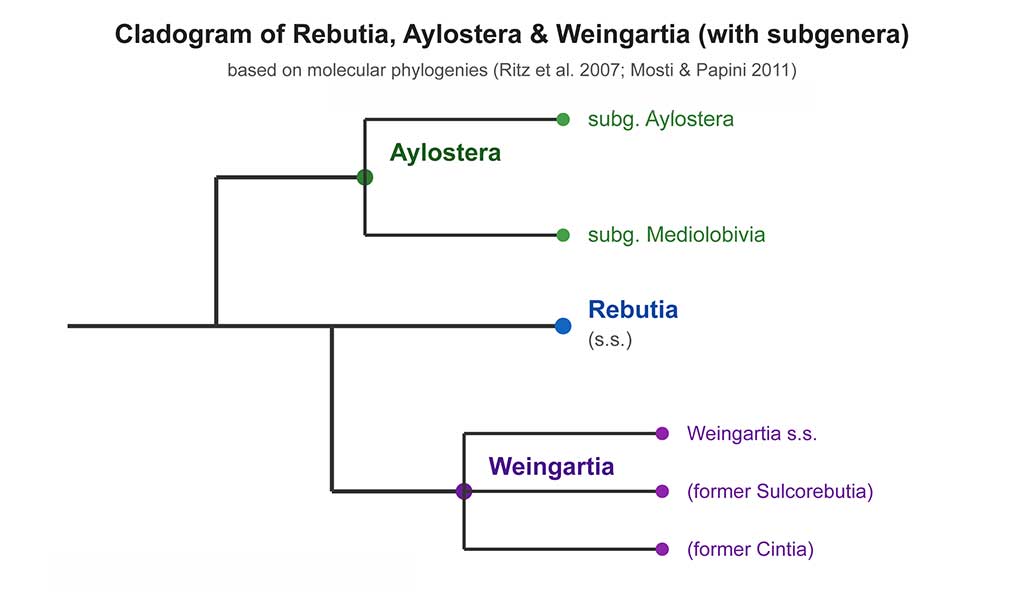
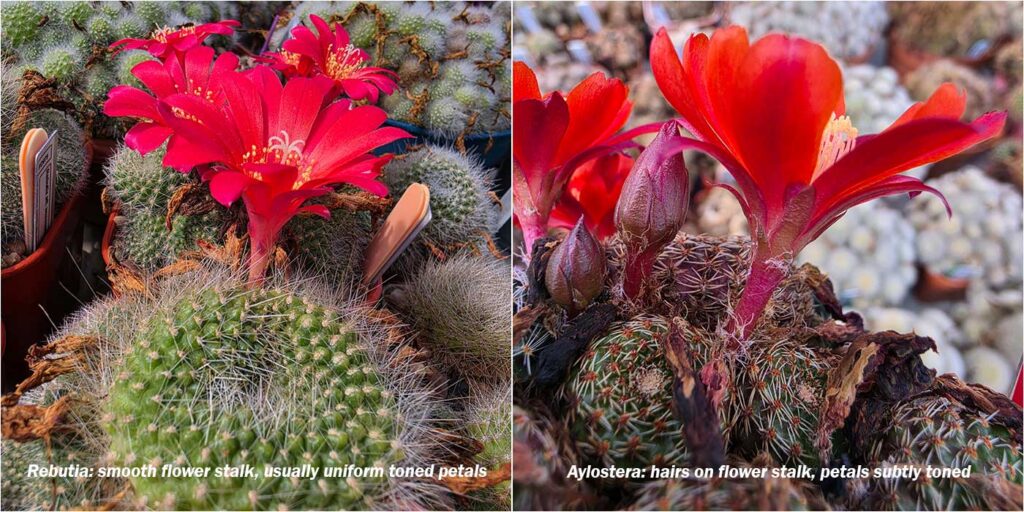
Through DNA studies, we now know that the genera Rebutia and Aylostera, although they look very similar, are actually not that closely related. In fact there are characteristics that can help with separating them (see below). Sulcorebutia and Weingartia, on the other hand, have been found to be so closely related to each other that they need to be included in the same genus. Weingartia is an older name than Sulcorebutia, so all the Sulcorebutias have become Weingartias.
The same goes for Mediolobivia, Digitorebutia, and a few others, which are all now Aylostera; and Cintia is now included in Weingartia.
Convergent evolution
Plants which, through DNA studies, have been found to have had different ancestral paths, yet look very similar, are said to have undergone convergent evolution. The pressures which have been brought to bear by the habitat or environmental conditions have caused adaptations which caused the plants to become similar-looking; for example, a small size, low to the ground in response to exposed high altitudes; dense spination in response to certain grazing animals; certain colours of flower (including their UV colours) in response to certain pollinators; etc.
Current view
We try to stay abreast of collective scientific opinion about the names and genetic relationships between plants, but it is difficult. New plants are being found all the time, and new DNA studies reveal new facts. Currently, we believe there to be three genera among the plants which used to all be “Rebutia“:
- Aylostera
- Rebutia
- Weingartia
There are a few oddities which have been found to be outside of these and now included in Echinopsis or other genera, but it is a small number.
Weingartia or Rebutia?
Although Weingartia (which now includes plants once called Sulcorebutia and Cintia) and true Rebutia are relatively closely related, they can be told apart by a few easy-to-see features. In Weingartia the spine clusters (areoles) sit off-centre and are recessed into a groove in the upper side of each little bump (the tubercle); the spines tend to be thicker and sturdier. In Rebutia the spine clusters sit more centrally on the outer face of the bump and are not recessed in the same way, and the spines tend to be fine and fragile. On the flower stalks, Weingartia has broad, overlapping scales while the scales on Rebutia are narrow and fewer.